


 Search
No data
通す (とおす) — to let pass; to allow through; to let through; to make way (for)
通す
 とおす
とおす 

と お す
JLPTN3
 Godan verb with 'su' ending, Transitive verb
  Full
Full 
To let pass; to allow through; to let through; to make way (for)
彼
kare
はおばあさんに
haobaasanni
道
michi
を
wo
譲
yuzu
り
ri
、
,
通
too
してあげた
shiteageta
。
.
He gave way to the old lady and let her pass.
To transmit (e.g. light, sound, etc.); to conduct (electricity); to let permeate (e.g. water through a fabric); to permit through; to let through (e.g. air); to run through (e.g. a pipe); to penetrate; to let in
銅
dou
はよく
hayoku
電気
denki
を
wo
通
too
す
su
。
.
Copper conducts electricity well.
To stick through (e.g. a hole); to force through (e.g. an opening); to thread (e.g. a needle); to put through
針
hari
に
ni
糸
ito
を
wo
通
too
すことができないので
sukotogadekinainode
縫
nu
い
i
物
mono
は
ha
好
su
きではありません
kidehaarimasen
。
.
I don't like sewing because I can't thread the needle.
To connect (e.g. two places); to open (a route, path, etc.); to link (e.g. by a road); to establish (a connection between); to join; to extend up to (somewhere)
山
yama
を
wo
通
too
して
shite
トンネル
tonneru
を
wo
通
too
した
shita
。
.
They drove a tunnel through the hill.
To pass (a student, applicant, etc.); to admit (e.g. a student); to let through; to let in
係官
kakarikan
は
ha
私
watashi
を
wo
通
too
してくれた
shitekureta
。
.
The official in charge let me in.
To lead (someone) into (a house, room, etc.); to show in; to guide in; to admit (someone)
彼
kare
はその
hasono
訪問者
houmonsha
を
wo
居間
ima
に
ni
通
too
した
shita
。
.
He admitted the visitor to the living-room.
To present logically; to make (e.g. one's argument) convincing; to be consistent (in one's reasoning); to stick to (e.g. one's principles)
彼
kare
は
ha
主義
shugi
を
wo
通
too
して
shite
譲
yuzu
らなかった
ranakatta
。
.
He stuck to his principle.
To go through (e.g. a middleman); to put as an intermediary; to mediate via (somebody); to do via (something)
今日
kyou
では
deha
、
,
ラジオ
rajio
や
ya
テレビ
terebi
を
wo
通
too
して
shite
、
,
大量広告
tairyoukoukoku
が
ga
何百万
nanbyakuman
もの
mono
人々
hitobito
に
ni
同時
douji
に
ni
メッセージ
messeeji
を
wo
届
todo
けている
keteiru
。
.
Today, through radio and television, mass advertising can reach millions of people at a time with its messages.
To pass (a law); to put through (e.g. a motion); to make way (for)
参議院
sangiin
はどんな
hadonna
改正案
kaiseian
も
mo
通
too
さなくても
sanakutemo
構
kama
わないようです
wanaiyoudesu
。
.
The Upper House seems bent on defeating any reform bills.
To listen through (a door, wall, etc.); to look through (e.g. a window)
To heat thorougly (of food); to cook properly; to warm well; to heat evenly
To dip into (e.g. a sauce); to pass through (e.g. a broth); to put through (e.g. boiling water)
To make (someone) approve (e.g. a plan); to force agreement; to push through (a proposal, idea, will, etc.); to have one's way
彼
kare
はやりたいことを
hayaritaikotowo
通
too
す
su
人
hito
だ
da
。
.
He is a man who will do what he wants.
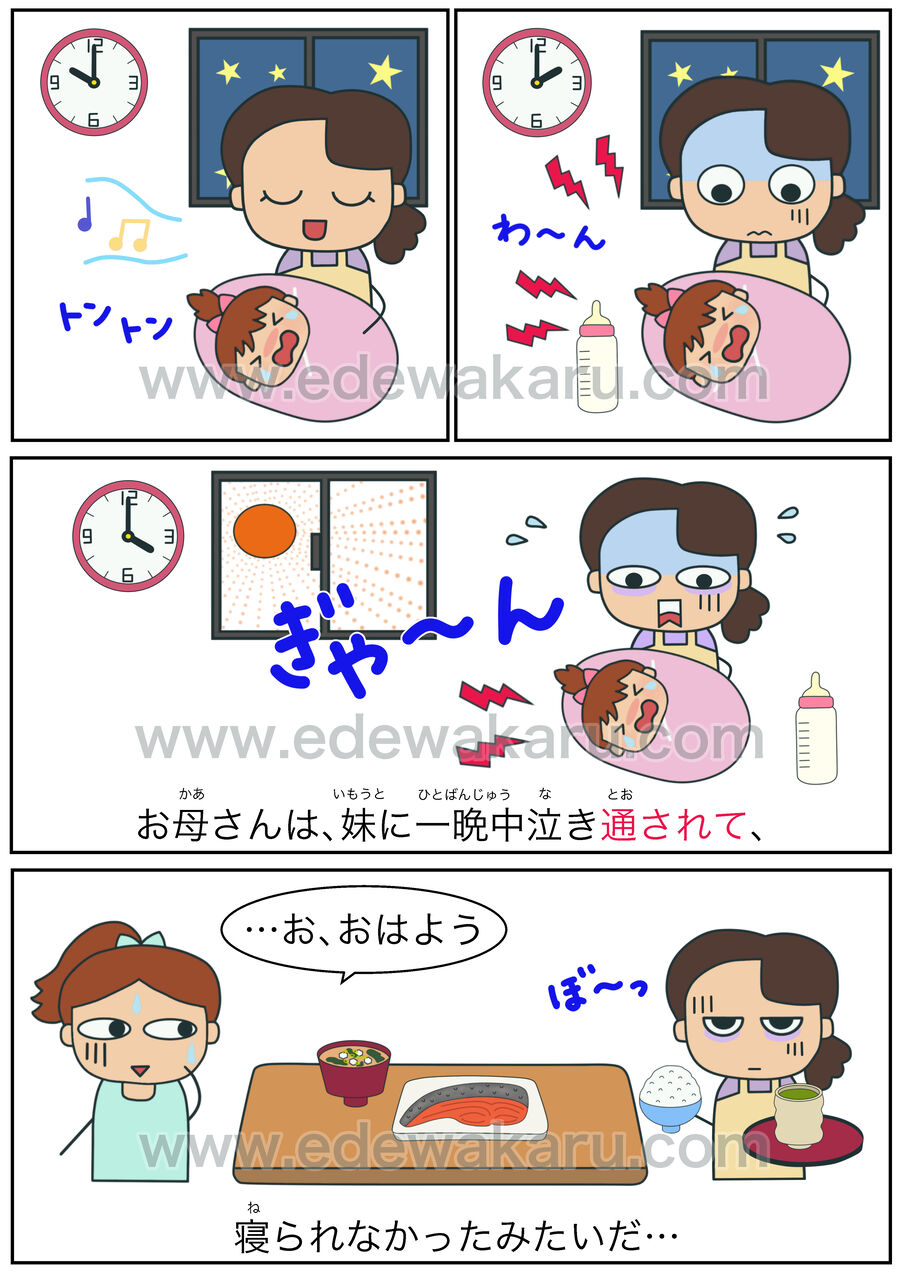
To continue (in a state); to persist in (doing); to keep doing; to remain (in a state)
彼
kare
は
ha
一生独身
isshoudokushin
で
de
通
too
した
shita
。
.
He remained single all his life.
To do through the lens of; to view from the angle of; to do from the perspective of
To do to the entirety of; to cover all of; to span the whole
To do from beginning to end without a break; to finish in one session; to do all at once; to do in one go
To relay (a message, an order, etc.); to convey (an intention, meaning, etc.); to send through; to pass on (e.g. information); to make heard (e.g. one's voice)
騒音
souon
がひどかったので
gahidokattanode
ベイリー
beirii
教授
kyouju
は
ha
自分
jibun
の
no
声
koe
を
wo
通
too
すことができなかった
sukotogadekinakatta
。
.
There was so much noise that Professor Bayley couldn't make himself heard.
Suffix, Godan verb with 'su' ending  Collapse
 To do ... to the end; to do ... continuously; to carry through ...; to complete ...
Image search
Verb conjugation table 通す
| Form name (形) | Word |
|---|---|
| Dictionary (辞書) | 通す/とおす |
| Past (た) | 通した |
| Negation (未然) | 通さない |
| Polite (丁寧) | 通します |
| te (て) | 通して |
| Ability (可能) | 通せる |
| Passive (受身) | 通される |
| Command (使役) | 通させる |
| Passive command (使役受身) | 通させられる |
| Conditions (条件) | 通せば |
| Command (命令) | 通せ |
| Will (意向) | 通そう |
| Prohibition (禁止) | 通すな |

Antonym of 通す
通す is used in practice


 Mazii MobileAvailable on iOS and Android
 Scan QR to download the app

About Mazii
Main features


